Cover Story
Protests against CAA, NRC organic: Nandita Das
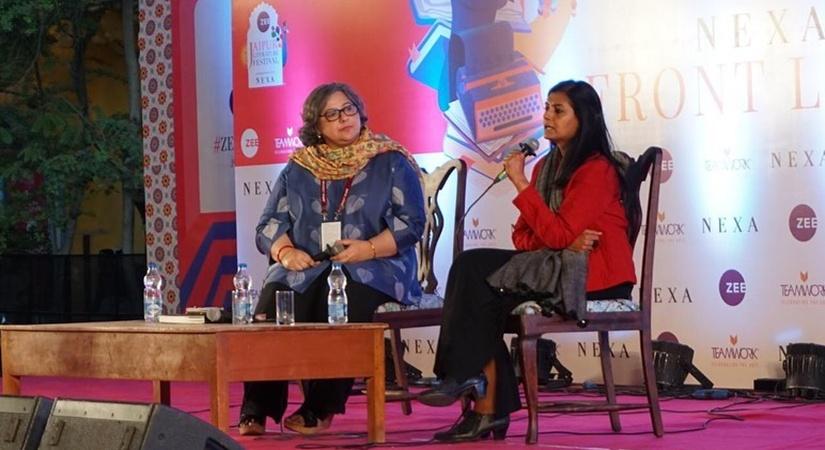
The digital revolution has democratised the practice of filmmaking: Das at JLF
BySukant Deepak
January 24, 2020 (IANSlife) Actor Nandita Das told IANS that the protests against CAA and NRC were organic and erupting almost simultaneously across the country without any political backing or support.
“Led by women and students from different religions, this protest is cry for everyone to speak up and lends his/her voice. At a time when the economy is falling, unemployment rate is high, and female foeticide is rampant, why divert energy to something as divisive as CAA and NRC?” she stressed on the sidelines of the Jaipur Literature Festival.
Known for directing critically acclaimed films like ‘Firaaq’ and ‘Manto’, this recipient of the Knight of the Order of Arts and Letters by the French Government, though excited about the fact that several new filmmakers are emerging with original stories and telling them in a novel way, feels key areas like distribution and theatrical release still need to be looked at in order to ascertain the emergence of truly independent cinema.
Das who has served on the jury of Cannes Film Festival twice, said, “The digital revolution has democratised the practice of filmmaking with the equipment becoming much less expensive, thereby giving a chance to more people to participate in this art form. However, if you are looking for a theatre release, it’s still a challenge as the distribution model is very traditional. The nexus between the producer, distributor and the exhibitor remains intact.”
Adding, when one makes a small film, it is still paramount to meet certain parameters for a commercial release – like getting it launched by a big production house or ensuring a major actor in the cast, the actor and director credits the Internet with wide exposure to the world of cinema. “People are getting to watch some fantastic world cinema, thanks to the Internet. And the same has surely broadened horizons.”
In an age when OTP is the flavour of the season, Das, who happens to be the first Indian to be inducted into the International Hall of Fame of the International Women’s Forum in the US and still swears by collective viewing, says, “When television started beaming, people wondered – is cinema going to die? The best part about OTP is that people are getting to see some excellent films in different languages, even Indian ones – Indian, Tamil, Malayalam and others. I am constantly getting feedback from people across the world on ‘Manto’. As far as creative freedom goes, it is up to us how we use it to tell powerful stories, Of course, one sees rubbish too, but I believe that by sheer numbers, good will emerge from the noise. One should never feel threatened by freedom. Time is the test of art. Also, this platform is giving so much work to writers, actors, technicians and directors. Everybody is busy, which is fantastic.”
A decade back, when she made ‘Firaaq’, Das wouldn’t like it when people addressed her as a ‘woman director’. But things have changed now, she says, “I used to get offended and would always answer that I didn’t know how it felt to be a male director. But over the years, I have warmed up to that label because I we need more woman making films. The female gaze is important. For a long time, men have controlled the narrative. Of course, this doesn’t mean that men haven’t made excellent films on women --- Shyam Benegal, Mrinal Sen, Govind Nihalani and Adoor Gopalakrishnan are excellent examples.”
Stressing that more literature and film festivals at different parts of the country can only bring good, Das elaborates, “Jaipur has become synonymous with JLF, we have the Biennale at Kochi and so many festivals spread across the country. Look at them from the audience point of view --- such a large number of people are getting to listen to and see works of people they have admired.”
Writing a feature film and a short film, besides a series, the actor laughs about the kind of roles being offered to her, “They tend to box you post 30. Moreover, just because I voice my social concerns, I am offered characters holding a flag. Frankly, I would like to portray parts which are more human… with their inherent weaknesses.”
(This article is a website exclusive and cannot be reproduced without the permission of IANSlife)
Sukant Deepak can be contacted at sukant.d@ians.in