
Cover Story
Barry John conferred with META 2020 Lifetime Achievement Award
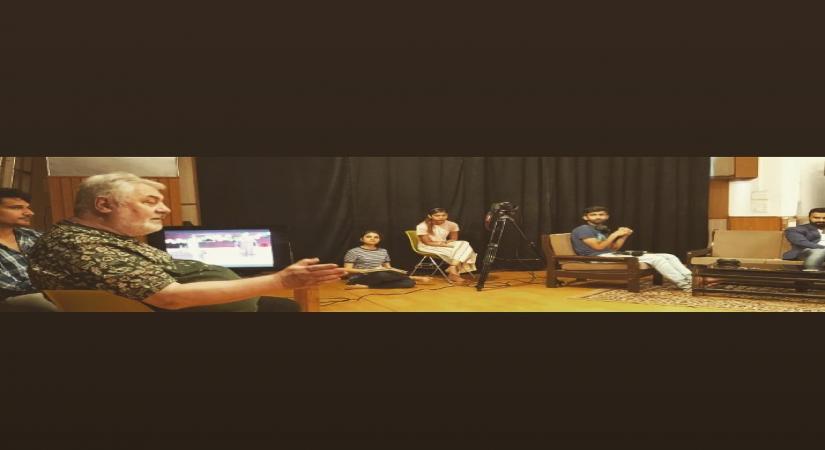
World over, writers and poets have been a source of irritation to the powers that be: Barry John
BySukant Deepak
New Delhi, March 9 (IANS) The Mahindra Excellence in Theatre Awards (META) and Festival 2020 conferred the META 2020 Lifetime Achievement Award on renowned director, actor, set designer, writer and teacher Barry John. A pioneer in the establishment of drama and theatre studies for different schools, he was also Founder-Director of the NSD’s Theatre in Education Company.
It has been a long journey for Barry John. Arriving in India at the age of 22, starting the Theatre Action Group (TAG) in 1973, one of the best known groups during its time in the Capital. He was part of the team that developed a theatre curriculum for schools after being approached by the NCERT and is now semi-retirement in hills of Dharamshala. He says it is nice to be remembered. “I hung up my boots such a long time back…” But the veteran theatre director, actor and teacher does look back fondly at the TAG days in Delhi.
“Twenty-five is a good age for a theatre group. The initial five years of work were intense and richly rewarding. It's difficult to believe in retrospect that we achieved as much as we did, but when the company began to drift away (to pursue careers that earned them salaries and to get married), and when I joined the NSD faculty, there followed a lean period. After a few years, a new company came into being and resurrected the group's energy and vitality. So, lacking the resources and funding to sustain work of quality created these waves of intense activity and lean periods,” says John.
Now living in a place where there is no play to be seen, John, recipient of the Sangeet Natak Akademi Award, whose list of students include Shah Rukh Khan, Manoj Bajpai, Shiny Ahuja, Frieda Pinto and Richa Chadha, besides guiding actors like Irrfan Khan and Anupam Kher during his years as a faculty member of the National School of Drama, has always made it a point not to teach star kids at the Barry John Acting Studio in Mumbai (exceptions being Varun Dhawan and Arjun Kapoor), which he set up in 2007. “Mainly because they refuse to join a regular class. They usually seek exclusive, customised, one-on-one training, but I don't work like that. Varun and Arjun joined the class like other students, so I didn’t have a problem with them coming aboard,” he revealed.
Barry believes the emergence of younger film directors from small-town India has been instrumental in giving a chance to young theatre talent in cinema, which has resulted in reducing nepotism, he says, “Undoubtedly. At last, the monopoly is being loosened.”
While stressing that training in theatre is important, but only when conducted by competent teachers, he adds, “ Sadly, there are way too many 'teaching shops' that are in the business of exploiting young people's passion for theatre. They tend to be in the bigger cities, especially Mumbai, because that's where the money is.”
Contrary to the belief held by many theatre directors, John believes that the integration of theatre actors into films is a progressive and positive development, and insists that it has happened all over the world and made the modern actor versatile.
As the conversation veers towards theatre in the West, he stresses that out there, it is a commercialised business supported by both government and private industry. It is unionised and guarantees minimum wages and humane working conditions. “It has achieved respect in cultural arenas and in education. It used to be a traditional pursuit of the upper classes for a long time, but it is only through the course of the 20th century that it has made itself available to all sections of society. In India, the rural areas have long held sway of its classical and folk forms as part of the religious and cultural fabric of the country. The upper and educated classes have looked down on theatre as a vulgar and an immoral activity, which is why women were barred from participation until recently. Film and its mass media economy has changed these traditional attitudes because there's big money in it. Television has served to reinforce this revolution.”
Ask him why India isn’t witnessing emergence of new playwrights at a time when fiction writers from here making waves across the world, and he says, “I agree that the shortage of playwrights is a worry and a key reason that theatre always seems to lag behind. It is, of course, a difficult skill, not easily or quickly acquired. And where do you acquire it? How many universities offer creative writing courses? Even the NSD does not have a Playwriting Department. Another reason, of course, is that there is no money in it.”
Remembering the time when NCERT had approached NSD to develop a a syllabus for Drama / Theatre Studies for Schools, which he along with Maya Rao and Abdul Lateef Khurana designed, John says, “This is a sad story. It took us about a year to evolve a comprehensive syllabus that had Drama working more as a way of teaching during Classes I, II and III, before establishing itself as a separate subject from Class IV onwards. In Class V, the students were to be devising their own short plays. Classes VI to VIII exposed them to different theatre forms such as ‘A Play Based On Their Own Lives’, ‘A Nukkad Natak’ and ‘A TIE Play’. The latter was a participatory play based on personal or social issues that the students performed for their peers, and using techniques that elicited audience participation. All performances were to be in-house. Classes IX and X covered the study of Indian Dramatic Literature, including folk Theatre of the students' own particular region. Classes XI and XII covered aspects of World Theatre and projects based on the students' personal interests, whether that be acting, theatre architecture, costume design, poster design, playwriting or whatever. This syllabus has been put on a shelf to gather dust because it was felt that there are too few teachers who can teach it!”
Talking about the case of the police arresting a school student, her mother and teachers for acting in a play that criticised the CAA, John feels that across the world, writers, poets, playwrights, and journalists have been a source of irritation to the powers that be. “They tend to be on the side of freedom, diversity and human rights, and are unwilling to bow down to non-democratic authority.”
The jury for the 15th edition of the awards was announced and comprises renowned playwright and filmmaker Mahesh Dattani, playwright and novelist Makarand Sathe, media expert Shailja Kejriwal, actress Sushma Seth, actor and theatre director Saurabh Shukla, actor-writer Vinay Pathak and theatre director Lillete Dubey. Barry says, “Having hung up my boots (forgive the football analogy) some years ago, it comes as a surprise to be remembered and awarded, especially to be counted among the distinguished list of past awardees. It is indeed an honour.”
Jay Shah, Vice President, Head – Cultural Outreach at the Mahindra Group, said, “This is indeed a landmark year for the Mahindra Excellence in Theatre Awards and as we look forward to the 15th edition, we're also delighted to be giving away the 10th Lifetime Achievement Award to a theatre legend, Barry John. His contribution to stagecraft, especially his focus on introducing theatre into the school education system, the use of drama therapy and his role in shaping the theatre and performance industry have been invaluable.”
(This article is a website exclusive and cannot be reproduced without the permission of IANSlife)
IANSlife can be contacted at ianslife@ians.in