
Cover Story
Reduce helplessness for a stable society: Sudha Murthy
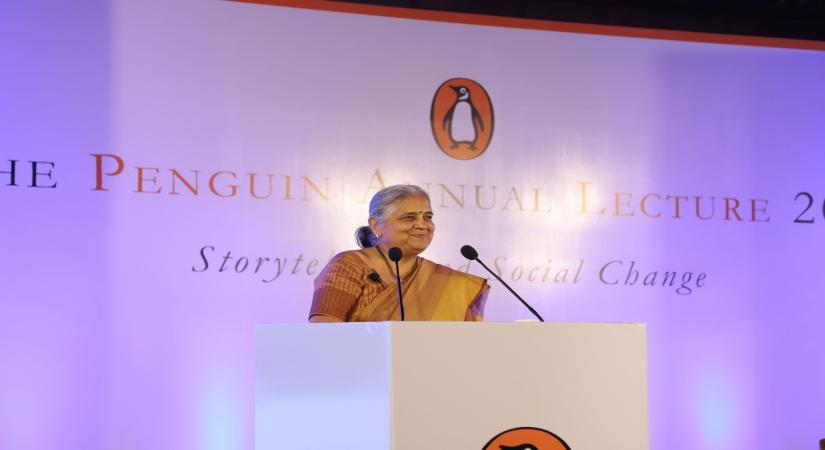
Not only social justice, education or poverty alleviation,Sudha Murthy knows her cinema well too!!
BySukant Deepak
December 18, 2019 (IANSlife) The conversation starts with Jean Paul Sartre and ends with Ayushmann Khurrana. And she seems happy about that. At Infosys’ subdued guesthouse in the capital, which shuns shouting ‘corporate’, Sudha Murthy, is sitting in a small room. The larger conference hall is reserved for waiting journalists.
In town for the Penguin Annual Lecture 2019, Murthy says that the many roles including being the Chairperson of the Infosys Foundation, a writer, social worker and administrator complete her.
“I must thank my excellent support system, else it would have been tough to do justice to them all. Frankly, there is not much demand from home and I don’t socialize much—no partying, get-togethers and very rare wedding appearances,” Murthy smiles.
She says that gives her enough time to write. “It is after all my cherished expression that gives me lets me talk about what I feel deeply about, my joys, the sorrows.” And adds, perhaps as an afterthought – “When something comes to my mind, I finish a book within 15-20 days.”
Murthy, however, doesn’t really like the fact that most schools, except perhaps some alternative ones, pay little attention to encouraging writing or push students towards other art forms.
There seems to be such a drastic change from our times when hobby classes were an integral part, she notes.
"Now, both schools and parents are only looking at making their kids computer proficient from an early age. Of course, it also has to do with the intense competition in face of a huge population, but it would be nice if they realised that encouraging creativity at an early age works wonders later on.”
As the conversation veers towards her latest book ‘The Daughter from a Wishing Tree: Unusual Tales from Women in Mythology’, the author insists that mythology, which has been written by men, does not really boast of many prominent women characters, except Sita and Draupdi.
“And this is despite the fact that several women have taken very strong and decisive decisions, which have changed dynasties. Yet, they remain unsung. The book is, therefore, about unusual women, away from the popular narrative, but extremely important.”
Stating that mythology happens to be an indispensable part of Indian culture, Murthy feels that it can be the saving light in the bleakest of times.
“Once you understand that it is not to be taken literally and is open to interpretation, it serves its true purpose – taking life head-on and never getting bogged down even in the worst of times.”
For Murthy, who for decades has been working with the underprivileged, the one emotion that always strikes her is – helplessness. “The moment people start feeling that, they take extreme measures. Look at the French Revolution or the Naxalite movement closer home. In order to ascertain a healthy and stable society, it is important to reduce that helplessness and that’s what I work for.”
Considering the fact that she was the only girl student in her engineering class and was the first woman engineer to be hired by TELCO, does she feel that things have really changed for women? “For educated women, yes. If you look at the southern states, the demand for dowry has come down considerably in most communities. Education, leading to financial independence has surely made women more empowered.”
Not only social justice, education or poverty alleviation, Murthy knows her cinema well too.
“I am a complete movie buff who still prefers to go for the late night show and seldom watch movies at home. Nowadays, I don’t miss any films starring Ayushmann Khurrana considering the fact that he makes such sensible choices. Well, I do miss the subtle style of directors like Basu Bhattacharya and Hrishikesh Mukherjee, but really admire Vidhu Vinod Chopra’s work among contemporary directors.”
(This article is website exclusive and cannot be reproduced without the permission of IANSlife)
Edited by Aditi Roy