
Cover Story
Come to my Mehfil
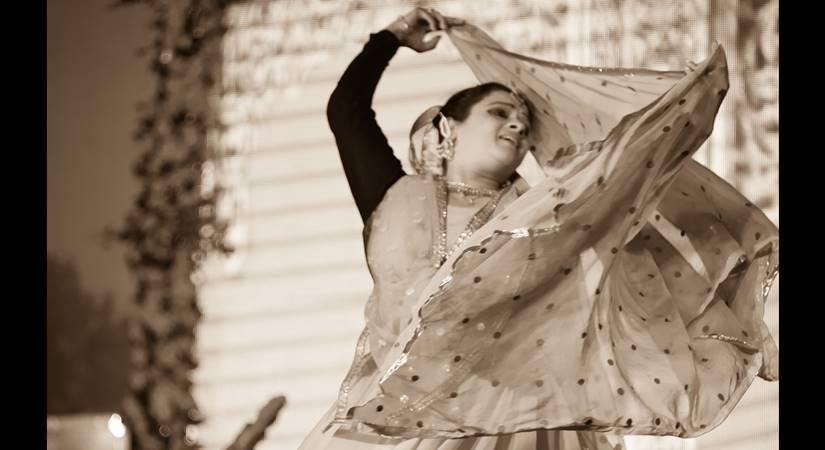
Khanum feels that the country needs more art festivals
By Sukant Deepak
December 30, 2023 (IANSlife) She says she does not think too much, just lives. In her ‘Mehfil’, an era in the past tense comes alive. There are couplets, dance, music, and anecdotes, but what is most striking is the piece of history of a bygone Lucknow of Nawabs she relives and introduces her audience to. Despite the packed auditorium, the performance maintains an intimate character -- ghazals, thumri, bandish, sher o shayri convey multiple shades of love through Kathak’s
abhinaya.
Before Rani Khanam, one of the few Muslim Kathak dancers and the only Indian Muslim classical dancer to perform to Islam verses goes to the stage during the recently concluded Serendipity Arts Festival held in
Goa, she is sitting alone in the green room. This she says is her time to gather herself. “What I am going to present is not just a performance but a culture. One feels the weight. Some time alone offers me the quiet to enter that era. Yes, the challenge is coming back to this world once it ends,” she tells IANS.
Looking back, coming from an orthodox family, she smiles that she never thought she would dance on stage one day. But destiny, she asserts can be a big thing. She does not want to emphasize her struggles, just says, “ I always listen to a small voice that comes from the inside. Whatever I do with art must have strong thought and
sensitivity. And if your thoughts are noble, there is no stopping you. A path appears. Yes, it is rare to see a dancer from my community, I just hope more children pursue it and get to experience the magic it
offers. There should be nothing stopping them from listening to their voice.”
Known for creating several social issue-based dance productions -- women’s rights, HIV, gender equality, and disability, Khanum feels that art cannot be conceived as decorative but has a much larger ‘purpose’. Stressing that an important function of the arts is to sensitize people and heal them, the dancer says, “Art has proven to be an immense catalyst for change. The work I have done on Muslim women’s rights is extremely close to my heart. It is sad that when talking about women’s rights, we tend to exclude them...The are treated is in
complete contrast to what has been written in the Quran. While triple talaq has become a thing of the past, there are still several issues that need to be resolved. It is paramount that Muslim women get an
education, only then they can think of standing on their own feet.”
Though known as a purist, Khanam does not hold back from improvizations. She says while it is important to pay adequate attention to aesthetics and the grammar of classical arts, a fresh approach goes a long way in making them accessible. “Now, being a purist does not mean that I am not open-minded,” she smiles.
Adding that Mayuri Upadhya, who curated the dance segment at Serendipity had a unique vision, Khanam says that she ensured that the dance segment was perfectly balanced. “She is not afraid of experimenting and has a 360-degree view of things. Curating such a big segment is no small task. Ensuring that everyone gets a voice is
tougher.”
Talking about her Sufiana Dance Ensemble (founded in 1989), a repertoire based on Islamic and Sufi verses in which production is based on Sufi master’s compositions, Islamic verses, Qawwalis, Indo-Persian compositions, and Sufi folk compositions, she says, “I was 12-years-old when I started learning Kathak. Over time, meditation
also happened to me. I did not want to dance only to a particular god. There were a few compositions on Allah -- and I understood that the connection to the almighty is what is paramount, not a particular diety. The first programme was for the King and Queen of Malaysia.”
Khanum feels that the country needs more art festivals to ensure that the young get more exposure to diverse art forms. “Festivals are platforms not just for artists but also those who come to witness them. It provides them with newer viewpoints and more ways of seeing. And seeing is believing, no?” she concludes.
(This article is website exclusive and cannot be reproduced without the permission of IANSlife)
IANSlife can be contacted at ianslife@ians.in