
Cover Story
The bond of friendship
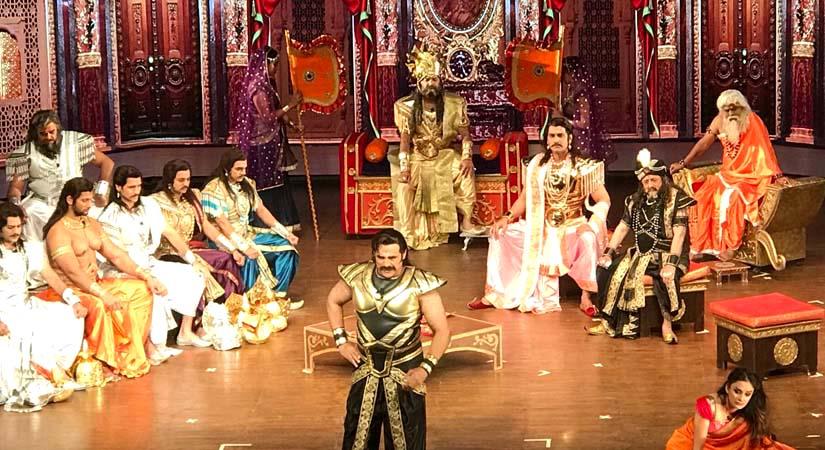
Puneet Issar's play Mahabharat: The Epic Tale narrates the epic from Kaurava prince Duryodhan’s point of view
ByDeepa Gahlot
September 26, 2019 (IANSlife) One of the most moving moments in the stage production Mahabharat: The Epic Tale, has Duryodhan, reviled as a villain in the epic, defending Karna, who is being humiliated by the Pandavas for belonging to a lower caste and thus not worthy of competing with Arjun. Karna then offers undying friendship and loyalty to Duryodhan, and refuses to abandon him during the Battle of Kuruskshetra, when Kunti reveals that she is his mother and begs him to join his brothers, the Pandavas.
The play, written and directed by Puneet Issar, brings to stage the memory of the time the nation used to be glued to their TV sets, watching B.R. Chopra’s grand epic unfold. Amazingly, 30 years later, Issar reprises his role of Duryodhan and brings back Gufi Paintal as Shakuni Mama, and Surendra Pal as Drona, who had played these roles in the serial, and it feels like time stood still for these actors; and for a section of the audience that remembers the popular serial.
Since audiences expect TV-style kitsch, the costumes and sets (the backdrops are projected) are garish. The strength of the play, however, is in its text. Issar, with his son Siddhant co-writing and also playing young Duryodhan (using an odd ‘yo dude’ body language and wearing boots), wrote it in verse, using chaste Hindi (though, some Urdu words inevitably creep in), and that did not lessen the enjoyment of the audience, that frequently burst into applause after some dramatic scenes.
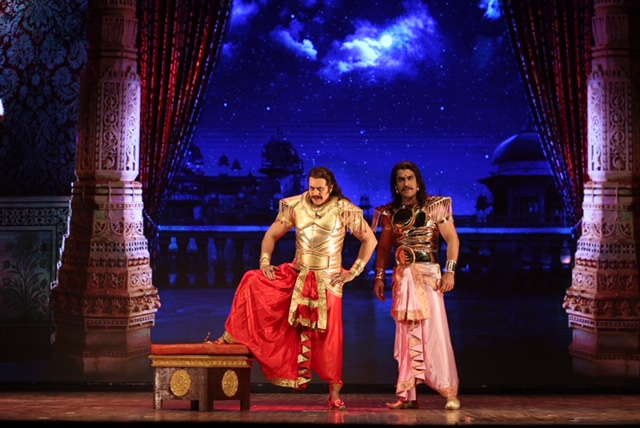
Issar, who played the title character in another production, Raavan Ki Ramayan, obviously wanted to give Duryodhan an image makeover too. The Kaurava prince, strong, arrogant, ambitious, who is willing to go into battle with his cousins to grab the throne of Hastinapur, has a noble side to him, that made him fight for the dignity of Karne. Later, during the battle, when Karna (Rahul Bhuchar, also the producer) is killed, he insists on lighting the funeral pyre of his friend, stating that the Pandava brothers did not merit the right.
The highlights of the Mahabharat — like Draupadi's vastraharan, Shakuni’s cunning plan to cheat at dice, the killing of Karna and Duryodhan are there, but the story is tailored towards Duryodhan’s point of view. Draupadi (a shrill Harleen Rekhi) insulted calling him “blind son of a blind man” when he slipped and fell in the Palace of Illusions, she mocked Karna, when he appeared at her swayamvar, and so she deserved the disrobing in court. However, he also argues that if he is at fault for dishonouring a woman, what about the husband who used her as a piece of property in the game of dice that led to the cataclysmic battle? What about Lord Krishna, who allowed the Pandavas to kill their opponents by devious means?
The point the play makes (through its narrator Dharti or Mother Earth, played by Meghna Malik) is that those who stand for Dharma (righteousness) often use Adharma to achieve their aims, while those considered evil might actually uphold the principles of Dharma.
The actors spoke the difficult lines with impressive clarity, though the wires from the body mics could have been concealed better. The backdrops could have been less greeting card-like gaudy, the costumes less garish. The effect is somewhat like watching a TV serial on stage, but that is also perhaps what appeals to the audience flocking to the shows.
(This article is a website exclusive and cannot be reproduced without permission of IANSlife)
Deepa Gahlot is an entertainment columnist.
Editing by Ritu Pandey and N. Lothungbeni Humtsoe